Sustainability reporting is becoming more complex. Organizations may need to prepare for CSRD, ISSB, UK SRS, CDP, SB 253, investor questionnaires, and internal reporting, using data from different teams, sites, systems, and suppliers.
Sustainability reporting, built on one connected data foundation
Find out how to streamline sustainability reporting with Sweep. Connect data, map frameworks, and build audit-ready disclosures across CSRD, ISSB, CDP, SB 253, and more.
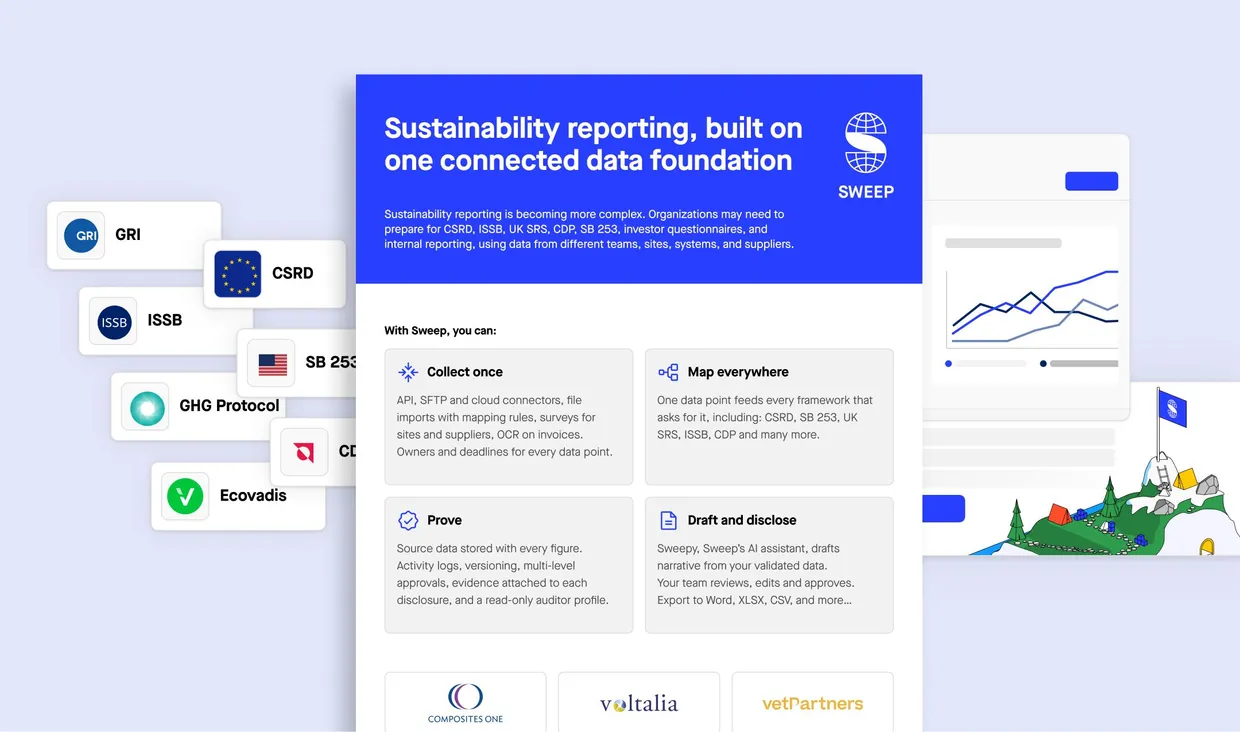
With Sweep, you can:
- COLLECT ONCE: API, SFTP and cloud connectors, file imports with mapping rules, surveys for sites and suppliers, OCR on invoices. Owners and deadlines for every data point.
- MAP EVERYWHERE: One data point feeds every framework that asks for it, including: CSRD, SB 253, UK SRS, ISSB, CDP and many more.
- PROVE: Source data stored with every figure. Activity logs, versioning, multi-level approvals, evidence attached to each disclosure, and a read-only auditor profile.
- DRAFT AND DISCLOSE: Sweepy, Sweep’s AI assistant, drafts narrative from your validated data. Your team reviews, edits and approves. Export to Word, XLSX, CSV, and more…
- Composites One went from no emissions reporting to SB 253-ready across 30+ US sites in 6 months, with a team of one.
- Voltalia streamlined CSRD with Sweep by simplifying double materiality, data collection, validation, and audit-ready reporting.
- VetPartners brought carbon, CSRD and stakeholder engagement into the Sweep platform across 550+ practices in 9 countries.
How Sweep works
From raw data to reporting-ready disclosures across every framework
Sweep connects the data, workflows, and controls needed to manage sustainability reporting at scale.
- Structure your organization: Build your org tree: legal entities, business units, countries, sites. Assign roles and permissions per group so each contributor sees only what they own, and every figure can be cut by entity or region.
- Collect the data: Sweep meets your data where it is: connect ERPs, cloud data lakes, and HR systems automatically through native integrations, SFTP, APIs, and custom connectors. Or, collect it through file imports, surveys, and guided workflows.
- Structure and validate: Automatically clean, structure, and standardize data at import. Quality controls, anomaly detection and AI-assisted checks fixes unit errors, gaps and duplicates. Route approvals to the right reviewers before data goes into your footprint.
- Map to every framework: Pre-configured modules link each data point to the indicators that use it, covering ESRS, SB 253, UK SRS, ISSB, CDP, GRI, SASB, and more. Start with framework-aligned data points, add custom ones to fit your business, and track your reporting coverage and progress year over year, all in one place.
- Draft with Sweepy: Live data populates quantitative indicators where available. Sweepy helps calculate additional data points and draft qualitative responses from your data and documents. All AI-generated outputs are clearly marked and require review and approval from your team.
- Disclose and reuse: Track completion by standard and by entity. Export to Word, XLSX, CSV… or push data downstream in real time with APIs. Next year, and for the next framework, the structure and the trail are already in place.
Meet Sweepy
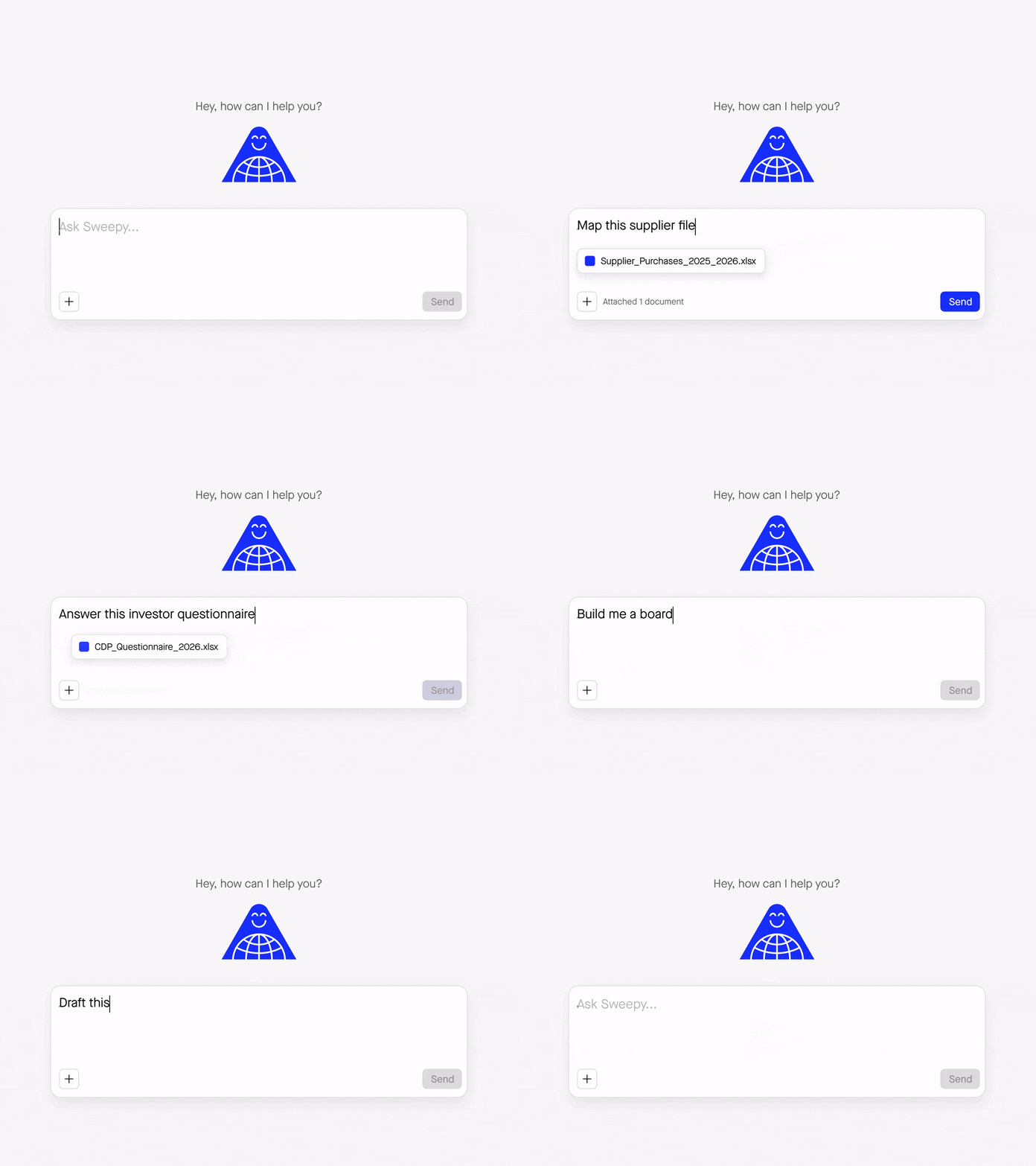
Sweepy is Sweep’s built-in AI assistant for sustainability data management and reporting. It helps map inputs to indicators, validate information, identify gaps, and support disclosure drafting.
Every major framework covered
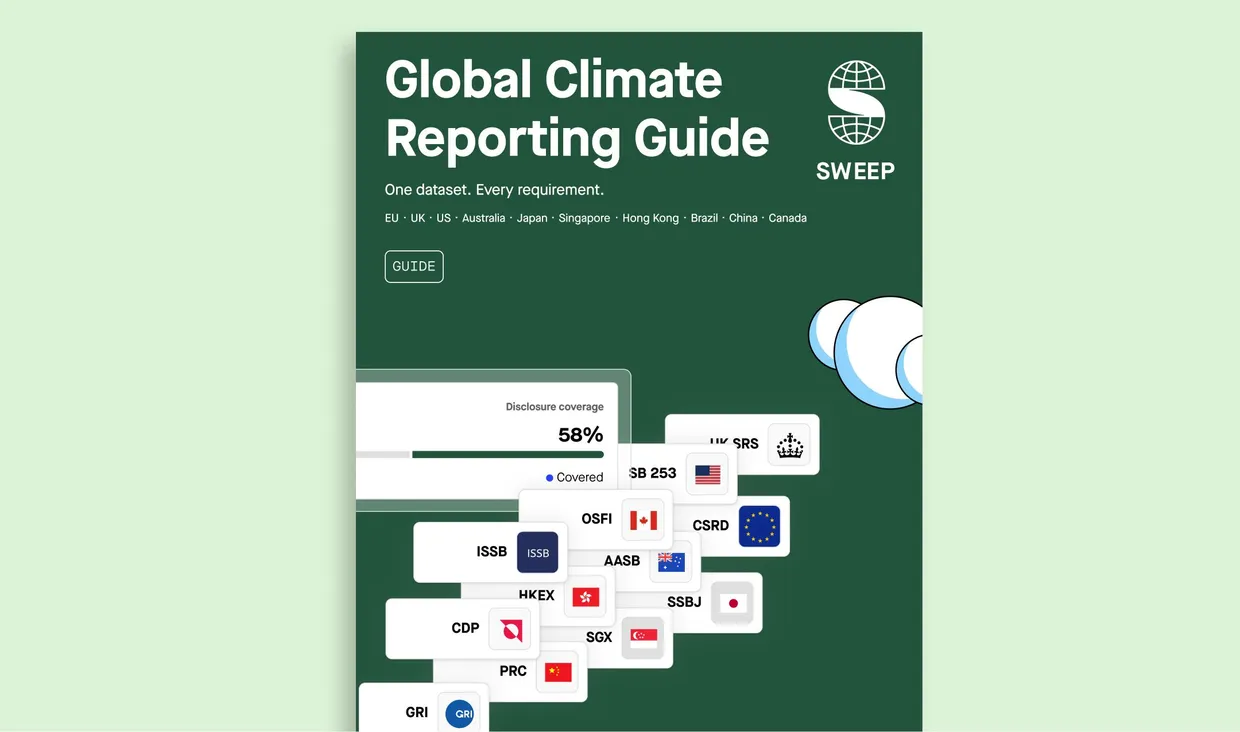
In practice, most large businesses need to report to multiple frameworks simultaneously and the requirements overlap in complex ways.
| Framework | Who asks | What Sweep does |
| MANDATORY AND REGULATORY-LED | ||
| CSRD / ESRS | EU regulation, with limited assurance | All 12 ESRS standards. Double materiality drives what you collect; completion tracked by standard and entity |
| California SB 253 and SB 261 | California regulation for in-scope US companies | Scope 1, 2 and 3 inventory and climate risk content from the same dataset, with the trail an assurer will ask for |
| UK SRS | UK standards based on ISSB | Reuses ISSB-aligned governance, strategy, risk and metrics data for UK reporting |
| ISSB (IFRS S1 and S2) | Jurisdictions adopting the global baseline | Structures sustainability and climate-related financial disclosures across governance, strategy, risk and metrics |
| VOLUNTARY AND STAKEHOLDER-LED | ||
| CDP | Customers, investors, supply chains | Answers populated from data already validated for other frameworks, year after year |
| GRI | Impact reporting, stakeholders | Quantitative indicators and qualitative evidence mapped to GRI disclosures |
| SASB, TCFD, GHG Protocol | Investors, sector peers | Sector metrics and climate disclosures layered on the same data, plus a GHG Protocol inventory |
| Custom and internal | Board, lenders, customer requests | Custom modules, indicators and dashboards built on the same governed data |
Common questions
Do we need to re-collect data for each framework? No. Each datapoint is collected and approved once, then mapped to every framework indicator that uses it.
What happens when a standard changes? Your data and its history stay in place. Sweep updates the module when a standard changes. For example, with CSRD, you choose which version of the ESRS to report on, and Sweep shows you which datapoints changed.
Can auditors work on the platform directly? Yes. A read-only auditor profile gives access to source data, evidence, approvals and activity logs.
How do we make sure our data is reviewed and ready to be reported? Assign roles and ownership down to the datapoint level. Each datapoint moves through validation steps before it’s reported, with an activity log recording who changed what and when.
Sweep can help
Sweep makes sustainability work for your business. Not the other way round. We connect all your sustainability data and turn it into business intelligence to help you unlock performance – from compliance and risk reduction, all the way to cost-savings, and market differentiation.
With Sweep, you can:
- Lower costs through real-time tracking and insights
- Strengthen supply chains with end-to-end visibility and engagement
- Deliver audit-ready sustainability and climate reporting with confidence
- Make sustainability intelligence available to everyone to optimize the business
See how we can help you on your sustainability journey