
On February 18, 2025, the Illinois House introduced HB 3673, creating the Climate Corporate Accountability Act. If enacted, Illinois would join California, New Jersey, New York, and Colorado in requiring large business entities to annually disclose their greenhouse gas emissions. The bill is currently pending with the House Rules Committee.
For companies doing business in Illinois, this law represents a significant shift toward climate transparency. Here’s what you need to know to prepare.
What is HB 3673?
Illinois House Bill 3673 creates the Climate Corporate Accountability Act. The Act requires large corporations to disclose their Scope 1, 2, and 3 greenhouse gas emissions annually to an emissions registry that will be publicly accessible.
What are Scope 1, 2, and 3 emissions?
- Scope 1 refers to direct emissions from sources the company owns or controls
- Scope 2 refers to indirect emissions from purchased electricity
- Scope 3 refers to all other indirect emissions from the value chain
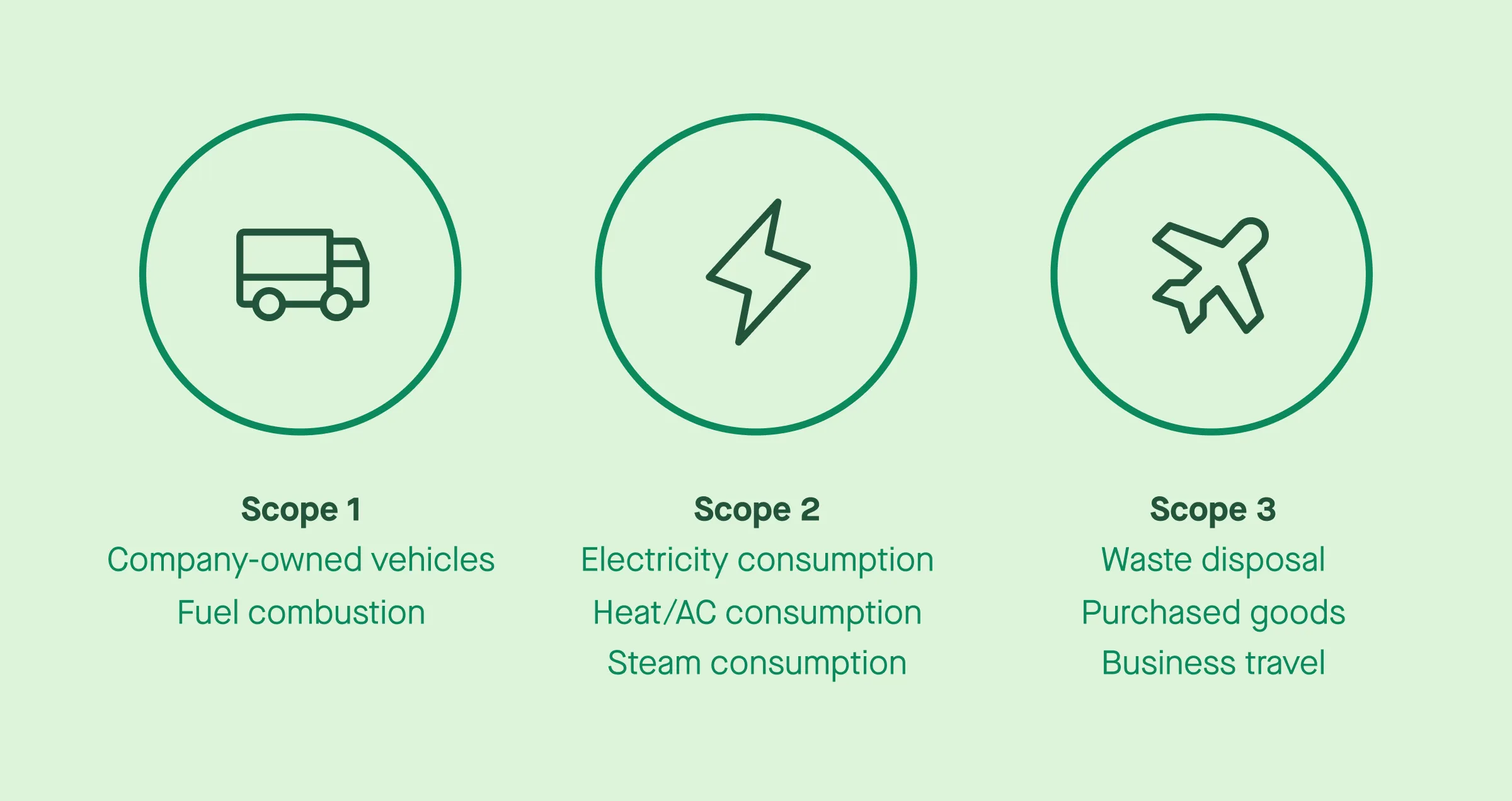
The Illinois climate reporting framework aligns with similar laws in California, New Jersey, and New York, creating consistency for businesses operating in multiple states. The emissions must be calculated using the Greenhouse Gas Protocol Corporate Accounting and Reporting Standard, ensuring standardized accounting practices across reporting entities.
The Act emphasizes climate transparency and equitable policy alignment across state lines. The bill aims to increase corporate environmental transparency and align with similar legislation in California, which pioneered this approach.
Which companies does the bill apply to?
The Act applies to all public or private companies with global annual revenue over $1 billion that conduct business in Illinois.
Importantly, this revenue threshold is based on consolidated global annual receipts, not just Illinois-based business. If your company meets the $1 billion threshold and has operations in Illinois, you’re likely a covered entity subject to the reporting requirements.
This approach is defined in accordance with how other states have addressed climate disclosure. New Jersey’s proposed Climate Corporate Data Accountability Act requires businesses with annual revenues exceeding $1 billion to report their greenhouse gas emissions. Colorado has introduced a bill requiring businesses with revenues over $1 billion to disclose their Scope 1 and 2 emissions starting in 2028, and Scope 3 emissions by 2029. New York has proposed the Climate Corporate Data Accountability Act, which mandates annual reporting of Scope 1, 2, and 3 greenhouse gas emissions by large entities.
What is the timeline for implementation?
The Illinois climate reporting requirements are set to begin in 2027 for Scope 1 and 2 emissions and in 2028 for Scope 3 emissions. Here’s the specific timeline once the bill is enacted:
By July 1, 2026: The Secretary of State must develop and adopt rules for the emissions reporting by July 1, 2026. The Secretary of State’s rulemaking process must be completed by July 1, 2026, to implement the climate reporting requirements.
By January 1, 2027: The reporting entities must disclose their Scope 1 and Scope 2 emissions for the prior calendar year by January 1, 2027. This covers emissions from the previous calendar year.
By July 1, 2027 (180 days after January 1): Reporting entities must disclose their Scope 3 emissions for the same calendar year no later than 180 days after that date.
Beginning January 1, 2028: Entities must continue to annually disclose emissions data in accordance with the regulations developed by the Secretary of State.
The first disclosures under the Act are set to begin on January 1, 2027, assuming the bill passes and receives approval from the Illinois House, moves through the legislative process, and is signed into law.
Administrative framework and enforcement
The Illinois Secretary of State will oversee the registry for emissions disclosures and enforce compliance regulations. The Secretary of State is responsible for developing and adopting rules for climate reporting in Illinois.
Registry development: The Secretary of State must contract with an emissions registry to create a reporting and registry program. The emissions registry is required to create a digital platform accessible to the public for housing disclosures on a dedicated website.
Data analysis: The state will contract with an academic institution to analyze emissions data and its impact on state environmental targets, helping Illinois identify progress toward its climate goals.
Verification requirements: Mandatory independent verification of all reported data is required, with minimum limited assurance defined in the final rulemaking. The Act mandates independent verification of all reported emissions data. Third-party verification of emissions data is emphasized to ensure the accuracy and reliability of reported information.
Enforcement: The Secretary of State is tasked with ensuring compliance and enforcement of the climate reporting requirements. The Illinois Attorney General is authorized to bring civil actions against companies that fail to comply with emissions reporting requirements. Penalties for non-compliance can reach up to $50,000 for subsequent offenses, with additional daily fines possible.
Any attempt to avoid compliance or failure to satisfy the reporting provisions could subject entities to these enforcement actions.
How can in-scope companies prepare?
Don’t wait for the effective date. Companies should begin preparation now, even while the bill is pending.
1. Identify if you’re subject to the law: Review your consolidated global revenue. If you exceed $1 billion and do business in Illinois, you’re likely a reporting entity under the Act.
2. Understand your emissions sources: Map out your Scope 1, 2, and 3 emissions. Scope 1 and 2 are typically easier to address first. For example, Scope 1 includes company vehicles and owned facilities, while Scope 2 covers purchased energy and transportation-related electricity.
3. Establish data collection systems: Businesses may face compliance challenges due to the complexity of tracking and reporting Scope 3 emissions. Start building processes to capture data from your entire value chain, including suppliers, transportation, and product use.
4. Prepare for verification: Mandatory independent verification of reported emissions data is required under climate disclosure legislation. Create systems that maintain clear audit trails and documentation.
5. Align with multi-state requirements: If you operate in California, Colorado, New Jersey, or New York, you’ll face similar but slightly different requirements. Build a system that can satisfy multiple state frameworks simultaneously.
6. Monitor the rulemaking process: The Secretary of State will develop specific regulations by July 1, 2026. Stay informed as rules are amended and provisions are clarified.
Current status and next steps
The bill is currently with the House Rules Committee. It must be approved by the full Illinois House, pass the state legislature, and receive the governor’s signature before becoming law.
While the bill is pending, the trend is clear: states will continue to pursue climate disclosure requirements even as federal regulations remain uncertain. Companies that prepare now will be positioned to report accurately beginning January 1, 2027.
The Illinois climate reporting framework creates a model for public accountability. The Act allows for transparency while providing clear rules for what entities must publicly disclose and how data will be housed on a public website accessible to stakeholders.
How Sweep can help
Managing climate disclosure across multiple state regulations requires a platform built for interoperability. Sweep helps reporting entities streamline their emissions accounting, from Scope 1 and 2 data collection to complex Scope 3 value chain reporting.
With Sweep, you can:
- Automate data collection in accordance with the Greenhouse Gas Protocol Corporate Accounting and Reporting Standard
- Maintain verification-ready records to satisfy mandatory independent verification requirements
- Track compliance across Illinois, California, Colorado, New Jersey, New York, and federal regulations from a single platform
- Prepare for annual reporting beginning January 1, 2027, with clear audit trails and public disclosure-ready formats
As Illinois and other states continue to create climate corporate accountability frameworks, the companies that invest in robust data management today will lead tomorrow.