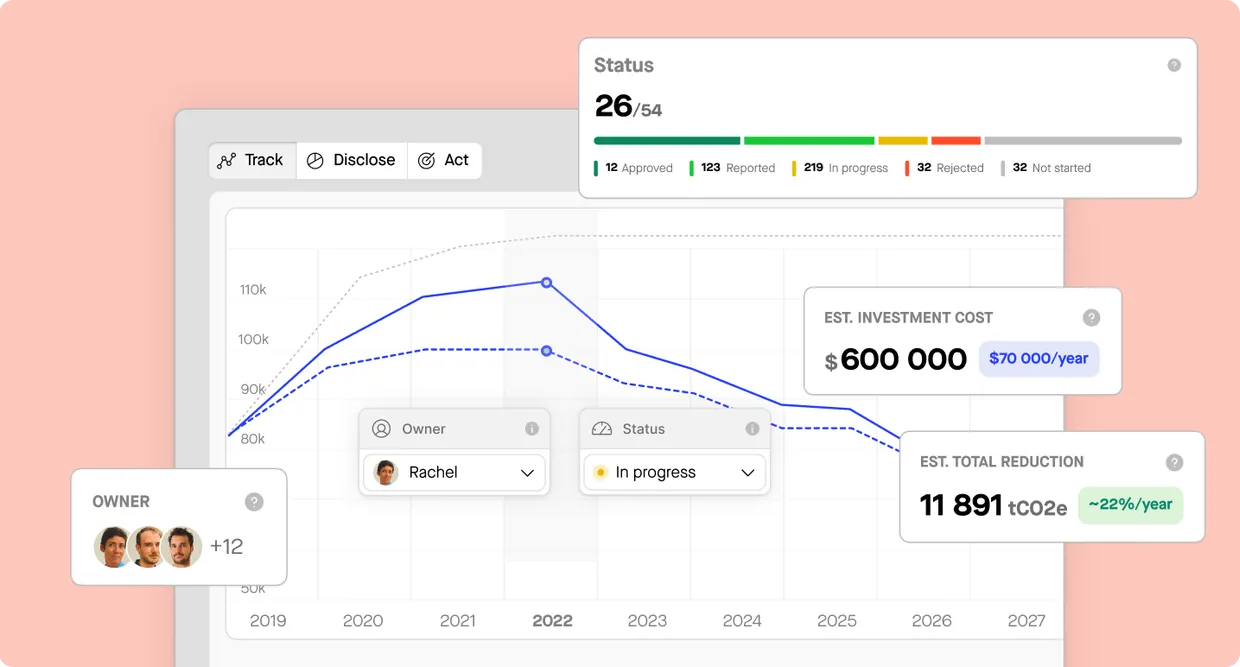
With Sweep, Swile is structuring and strengthening its carbon data to better manage its decarbonization strategy, meet growing customer expectations, and reinforce its value proposition.
How Swile Uses Sweep to Structure and Strengthen Its Carbon Data

Company
Swile is a French technology company founded in 2018. It brings together employee benefits, business travel, and business expenses on a single platform.
Size
860 employees
Industry
Technology and business services
Headquarters
Montpellier, France

« Sweep has given us something we did not have before: auditability. »

Coline Vaillant
Sustainability Lead
Key figures
- Scope 1, 2, and 3 emissions tracked in line with the GHG Protocol
- 97% of Swile’s carbon footprint comes from Scope 3
- ESG criteria account for up to 20% of the overall score in some RFPs
- 2030 decarbonization targets validated by SBTi Services in 2026
- B Corp™ certification and an EcoVadis Gold rating achieved in late 2025
| Before Sweep | With Sweep |
| A carbon footprint calculated at a very high level | A granular, robust, and reliable assessment |
| Carbon data that was difficult to understand and use | Carbon accounting expertise embedded in-house |
| Limited visibility into the most important areas for action | A clearer understanding of impacts and areas for action |
| Emissions factors that were difficult to keep up to date | Version control and simplified identification of the latest emissions factors |
| Carbon data that was not fully integrated into ESG management | Centralized, structured, and actionable data to support decision-making |
About Swile
Swile is one of France’s leading employee benefits companies. From day one, the company has been committed to making employee benefits more digital and accessible. Its offering includes meal and gift benefits provided by employers and works councils.
Today, Swile is expanding into new markets, including business travel and corporate expense management, with the ambition of becoming the go-to platform for business payments.
Sustainability is an integral part of Swile’s value proposition. It is reflected in the company’s practices, culture, and innovation, with the goal of improving the customer experience and contributing to a more responsible ecosystem.
Swile’s sustainability strategy is built around two pillars. The first focuses on the company’s foundations, embedding sustainability into its operations, governance, and culture. The second focuses on innovation, with the development of increasingly responsible solutions from the outset, as well as features that enable customers and users to take concrete action in the areas where they have the greatest impact.
This approach is supported by several recognized standards and frameworks, including B Corp™, EcoVadis, the Responsible Digital Label for technology activities, SBTi (the Science Based Targets initiative), and CDP (the Carbon Disclosure Project).
The challenge
Swile is committed to a climate strategy that includes reducing its greenhouse gas emissions. This implies being able to measure the carbon footprint of both the group as a whole and its products and services. Swile also helps its customers advance their own sustainability journeys, for example by promoting more responsible business travel practices.
Improving the accuracy and reliability of its carbon footprint measurement
Before implementing Sweep, Swile’s initial carbon assessments provided a high-level view of its carbon footprint. While this approach offered a useful first estimate, it made the data difficult to interpret and limited the team’s ability to identify concrete opportunities for improvement.
“We had a carbon footprint, but it was difficult to use. Turning the results into clear, actionable insights was a real challenge.”
Coline Vaillant
Sustainability Lead
The solution
Swile now uses Sweep to measure its Scope 1, 2, and 3 emissions in line with the GHG Protocol and to track its emissions reduction trajectory, including an intensity target for Scope 3 emissions based on the company’s value added.
Several Sweep features are particularly valuable to the team:
- Sweep’s data tree, which provides a customized representation of Swile’s organizational and operational realities;
- Sweepy, Sweep’s AI, which the team uses to build dashboards tailored to the company’s management and reporting needs;
- Emissions factor version control, which makes it easier to identify the latest factors and strengthen the traceability of calculations.
Sweep enables Swile to centralize its carbon data, better track its calculation methodologies, and build a more reliable foundation for managing its progress.
The results
Carbon accounting expertise brought in-house
With Sweep, Swile has professionalized its approach and built carbon accounting expertise internally. The team now has a stronger foundation for understanding its impacts, tracking progress, and identifying the most relevant areas for action.
This has enabled Swile to deepen its carbon accounting work year after year, while gaining greater accuracy, reliability, and control over the process.
Better-structured ESG data
Centralizing carbon data in Sweep supports the broader structuring of Swile’s ESG data. Carbon data plays a critical role in this effort by helping the company measure progress, inform decisions, and better prioritize its actions.
A more refined decarbonization strategy
As its carbon assessment becomes more granular each year, Swile is developing a clearer understanding of its impacts, the most actionable levers for reduction, and the areas where it can make the greatest progress. This is helping the company further develop and strengthen its climate strategy.
In 2026, Swile reached an important milestone when its emissions reduction targets for 2030 were validated by SBTi Services, the organization responsible for reviewing and validating companies’ climate targets under the SBTi methodology (Science Based Targets initiative).
« Our carbon footprint assessment is becoming increasingly reliable and precise. This progress is essential to building a robust decarbonization strategy grounded in the realities of our business. Having our carbon data centralized in Sweep makes decision-making easier. »
Coline Vaillant
Sustainability Lead
Putting carbon data to work for customers
Social and environmental requirements are playing an increasingly important role in commercial relationships. At Swile, ESG criteria can account for up to 20% of the overall score in some RFPs.
« By centralizing our carbon data in Sweep, we are better equipped to meet our customers’ increasingly specific and strategic expectations around environmental performance and decarbonization. Sweep gives us a more accurate view of the impact of our activities and services. It enables us to provide our customers with reliable, meaningful data. »
Coline Vaillant
Sustainability Lead
Sweep is therefore part of a broader data-driven management approach that sits at the heart of Swile’s sustainability strategy.
Next steps
Following the validation of its emissions reduction targets by SBTi Services, Swile is continuing to translate its commitments into concrete actions and further strengthen its emissions reduction program.
Supplier engagement is a key priority. Scope 3 emissions account for 97% of Swile’s carbon footprint, making collaboration across its broader ecosystem essential.
Swile has already begun working with strategic suppliers through a collaborative, co-development approach. The next step is to extend this work to additional suppliers in order to:
- improve the accuracy of impact measurement;
- develop a better understanding of the main reduction levers;
- collectively improve the environmental performance of the value chain.
Sweep will support this work by providing a structured framework to centralize data, track changes over time, and document progress.
Ready to transform your sustainability reporting strategy?