IBM Envizi is used by enterprises managing ESG disclosures, emissions reporting, auditability requirements, and sustainability data across multiple systems and reporting frameworks.
But is it right for your organization?
This review explores how Envizi works, the capabilities it offers for ESG data management and reporting, and where it may or may not fit depending on how sustainability is managed within the organization.
What is Envizi and who is it best suited for?
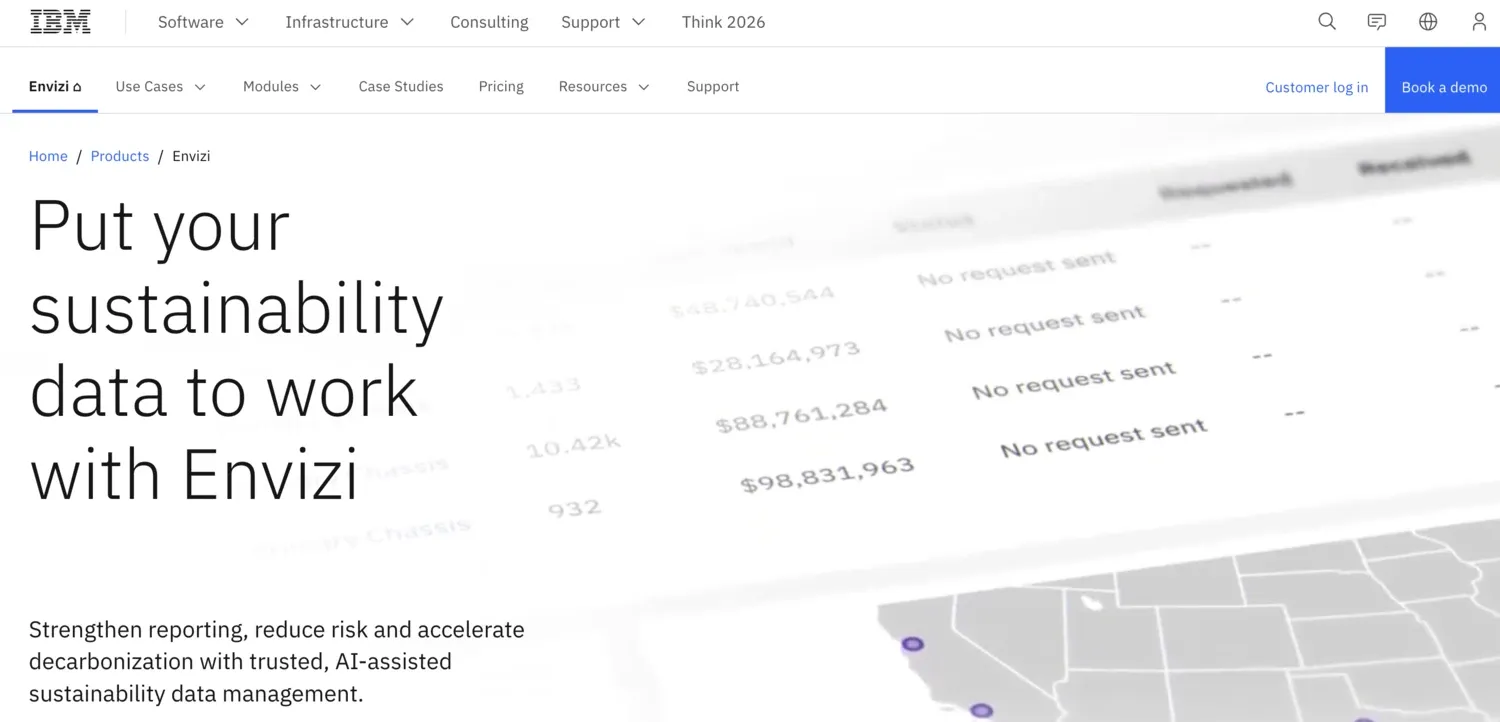
Envizi is an ESG data management and reporting platform from IBM, designed to help organizations centralize sustainability data across complex enterprise environments.
It is used by large organizations where sustainability reporting depends on consolidating data from fragmented operational systems while maintaining auditability, governance, and reporting consistency across the enterprise.
The platform offers a range of features that support sustainability, finance, and reporting teams:
- Automating ESG data ingestion from ERP systems, utilities, supplier portals, spreadsheets, and operational systems
- Structuring sustainability data using consistent tagging and governance models
- Supporting complex organizational hierarchies across regions, sites, assets, and business units
- Maintaining finance-grade audit trails and validation workflows for ESG reporting
- Improving Scope 3 emissions visibility across supplier and operational datasets
This approach allows organizations to create a more centralized and reliable ESG data foundation for reporting, disclosures, and enterprise sustainability management.
Envizi’s core features and capabilities
Automated ESG data ingestion at scale
Envizi is designed to centralize sustainability data from a wide range of enterprise systems and operational sources. The platform supports automated data ingestion from ERP platforms, utility providers, IoT systems, spreadsheets, supplier portals, and other operational tools.
This helps reduce manual data collection processes while improving consistency and visibility across large reporting environments.
Consistent data governance and reporting structures
The platform applies configurable metadata and tagging structures to ESG data as it enters the system. This allows organizations to maintain more consistent datasets across emissions calculations, dashboards, forecasts, disclosures, and reporting workflows.
By standardizing how sustainability data is categorized and reused, Envizi helps reduce duplication and simplify ongoing reporting governance.
Flexible organizational modeling and enterprise roll-ups
Envizi supports complex organizational structures across regions, business units, assets, subsidiaries, product lines, and operational entities. Sustainability data can then be aggregated and rolled up across different reporting views depending on business or regulatory requirements.
This flexibility is particularly useful for multinational organizations managing sustainability reporting across diverse operational environments.
Finance-grade validation and auditability
Governance and auditability are critical to Envizi’s positioning. The platform includes automated data quality checks, validation workflows, and full audit trails to support ESG reporting and disclosure processes.
This helps organizations maintain more traceable and defensible sustainability data across internal reporting, assurance, and regulatory requirements.
Scope 3 emissions intelligence for supply chains
Envizi also supports supplier-level emissions analysis and large-scale Scope 3 data management across supply chains and operational networks.
The platform aggregates and structures supplier emissions data to support emissions calculations, reporting workflows, supplier engagement, and broader supply-chain decarbonization initiatives.
Notable Envizi customer example
Ikano Group, a multinational organization operating across retail, banking, real estate, manufacturing, insurance, and analytics businesses, implemented IBM Envizi to support ESG data management and CSRD readiness across its global operations.
With sustainability reporting requirements expanding across multiple business units and regions, Ikano needed a more centralized and auditable approach to ESG data collection, governance, and reporting. The scale of the challenge was amplified by the complexity of the organization, which spans six businesses across three continents.
Envizi was implemented to help the Ikano Group:
- Centralize ESG data collection and reporting across multiple subsidiaries and operational environments
- Support CSRD and ESRS reporting requirements with more structured governance workflows
- Automate ESG data capture and reduce manual reporting processes
- Create a more consistent enterprise-wide sustainability data foundation across business units
The implementation also enabled Ikano Group to manage more than 15,000 ESG data types across the organization while supporting cross-functional collaboration between finance, sustainability, legal, HR, operations, and executive leadership teams.
Potential limitations and considerations
Envizi was built for large enterprise reporting environments with complex ESG data management requirements. Organizations with smaller sustainability programs or less mature reporting processes may find the platform’s implementation scope and governance structure more extensive than necessary for their current needs.
Because the platform is centered around ESG data architecture, reporting governance, and enterprise coordination, organizations looking for more workflow-driven sustainability management across operational teams may still require additional systems or processes alongside the platform.
Implementations can also involve significant coordination across internal systems, reporting structures, and business units, particularly in organizations managing large operational footprints and multiple reporting frameworks.
Comparing Envizi with other ESG data management and sustainability platforms? Explore our guide to Envizi alternatives.
How does Sweep compare to Envizi?
Sweep and Envizi both support enterprise sustainability management, but they approach the challenge from different operational perspectives.
| Area | Sweep | Envizi |
| Core focus | Sustainability management, workflows, and sustainability intelligence | ESG data management and reporting infrastructure |
| Primary users | Sustainability, operations, procurement, finance, and supply chain teams | Sustainability, finance, reporting, and governance teams |
| Reporting approach | Workflow-driven sustainability data management | Centralized ESG reporting and governance architecture |
| Sustainability workflows | Cross-functional sustainability coordination and operational management | Enterprise data consolidation and reporting governance |
| Scope 3 management | Supplier collaboration and operational sustainability workflows | Large-scale supplier emissions aggregation and reporting |
| AI positioning | Sustainability workflow automation and operational insights | Data governance, reporting automation, and ESG data structuring |
| Best suited for | Organizations connecting sustainability data with operations and strategy | Organizations centralizing ESG reporting and enterprise sustainability data |
In a nutshell:
Envizi is strongest in organizations where ESG reporting, governance, and centralized sustainability data management are the primary priorities.
Sweep is an ideal fit with organizations looking to connect sustainability reporting with operational workflows, supplier collaboration, and broader sustainability intelligence across the business.
Choosing the right approach to operational sustainability management
Envizi is designed for organizations that need stronger control over ESG data governance, reporting consistency, and enterprise-wide sustainability coordination. In large reporting environments, this type of centralized architecture can help reduce fragmentation across systems, reporting processes, and business units.
Yet, for organizations trying to operationalize sustainability more broadly across procurement, supply chain, operations, and cross-functional teams, workflow flexibility and ongoing collaboration may become equally important alongside reporting infrastructure.
Book a demo to see how Sweep helps organizations connect sustainability reporting, operational workflows, and sustainability intelligence within a single platform.