While answering these questions provides an initial indication of whether EPR applies to your business, businesses should confirm with official regulatory guidance before determining their compliance obligations.
Who is considered a producer under US EPR laws?
Under US packaging EPR laws, the responsible producer is generally the business legally accountable for covered products or packaging placed on the market. However, determining which company bears that responsibility isn’t always straightforward when several businesses could be involved in the manufacturing, branding, importing, and selling of the same product.
Producer responsibility typically follows a hierarchy, with brand owners taking priority. If the brand owner doesn’t meet the relevant state’s criteria, responsibility could fall to another business in the supply chain, such as the importer or distributor. It means EPR obligations can apply to manufacturers, brand owners, importers, distributors, and retailers selling private-label products, as well as e-commerce businesses, which may have obligations when selling covered products or introducing shipping packaging into regulated states.
A US retailer selling snacks manufactured by a third party under its own private label may be considered the responsible producer, even though it doesn‘t manufacture the products itself.
To determine which entity is responsible, businesses should consult the definitions of “producer” in each state’s EPR legislation or official regulatory guidance. These explain the order of responsibility between brand owners, manufacturers, importers, and other businesses in the supply chain.
The Circular Action Alliance (CAA) is a great practical starting point that provides state-specific resources to help producers understand their obligations.
What is Circular Action Alliance (CAA)?
Circular Action Alliance (CAA) is a nonprofit, producer-led organization that helps businesses meet packaging EPR requirements. It serves as the approved producer responsibility organization (PRO) in several US states, coordinating registration, packaging data reporting, and producer fees.
Its Producer Resource Center provides state-specific guidance, reporting resources, and information about compliance deadlines.
Which products and businesses are covered by US EPR laws?
US packaging EPR laws generally cover materials used to contain, protect, transport, or present products, including paper, cardboard, plastics, glass, and metals. Normally, this covers three forms of packaging:
- Primary packaging: Materials directly containing a product, such as plastic bottles, food wrappers, and glass jars.
- Secondary packaging: Materials grouping products together, such as cardboard multipacks and protective wrapping.
- Shipping packaging: Boxes, cushioning materials, and other packaging used to deliver products to customers.
Coverage varies by state. For example, Oregon’s Plastic Pollution and Recycling Modernization Act includes printing and writing paper, such as newspapers, magazines, and office paper, while California’s SB 54 focuses on single-use packaging and plastic food service ware.
Small business and other EPR exemptions
Some states exempt smaller businesses based on annual revenue or the quantity of covered materials they place on the market. However, understanding whether your business meets this is complicated because there is no universal US exemption threshold. Oregon uses a $5 million global gross revenue threshold; other states apply lower limits or inflation-adjusted figures.
Exemptions can also apply to specific products or packaging materials, particularly where separate regulations already govern their collection, recycling, or disposal. For example, California’s SB 54 excludes certain packaging used for prescription drugs, medical devices, and beverage containers, which are covered by separate recycling legislation.
The key point: Meeting an exemption threshold in one state doesn’t automatically exempt a business in another. Businesses must assess the relevant revenue, packaging volume, and product-specific criteria for each state in which they operate.
How do EPR exemption thresholds vary by US state?
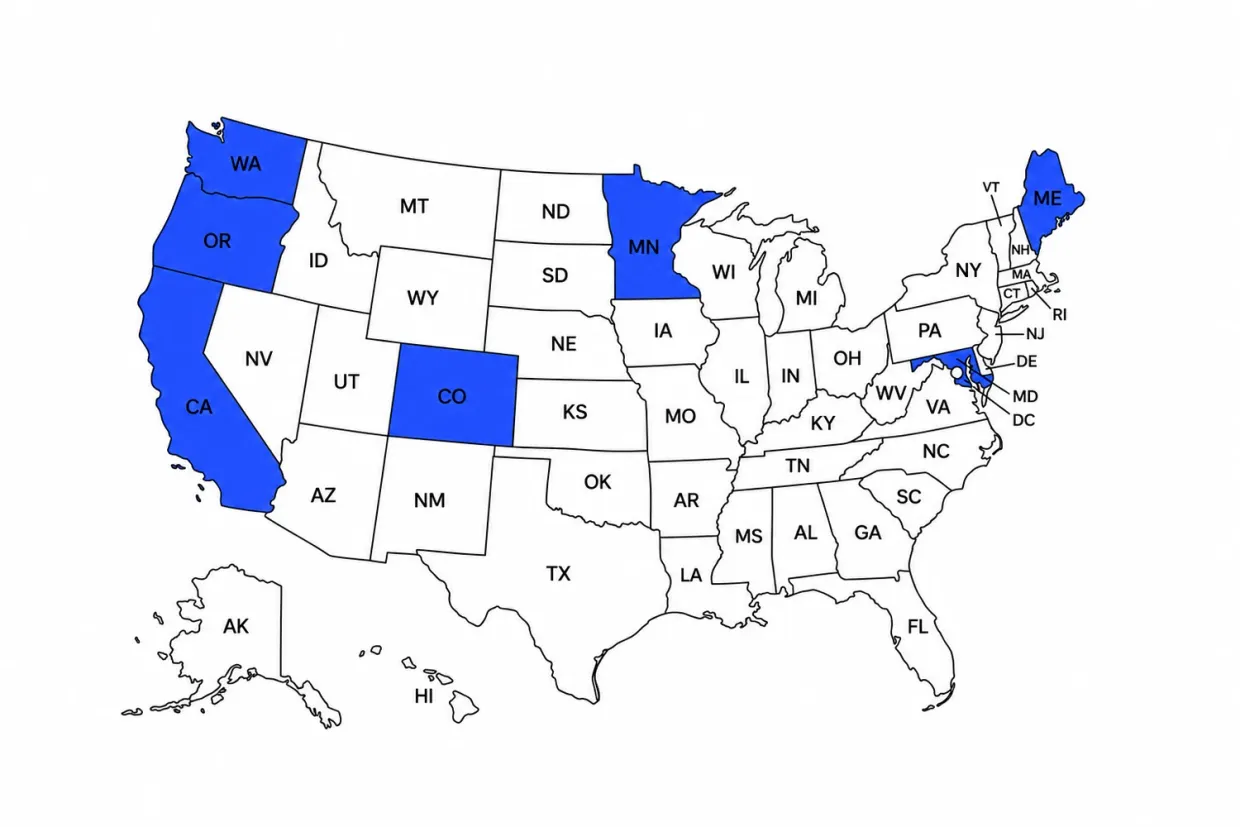
Each of the seven US states that have enacted comprehensive packaging EPR laws – California, Colorado, Maine, Maryland, Minnesota, Oregon, and Washington – has its own eligibility criteria, including revenue thresholds and packaging volumes for certain products or businesses.
The table below compares the main small-business exemption thresholds.