Workiva is one of the most widely used platforms for regulated enterprise reporting. Originally built around financial reporting and SEC filings, the platform has expanded into ESG and sustainability reporting as disclosure requirements have become more integrated across finance, risk, and compliance functions.
Is it the right platform for your organization, though?
This review explores how the platform works, the capabilities it offers for ESG reporting and compliance, and where it may or may not fit depending on how sustainability is managed within the organization.
What is Workiva and who is it best suited for?
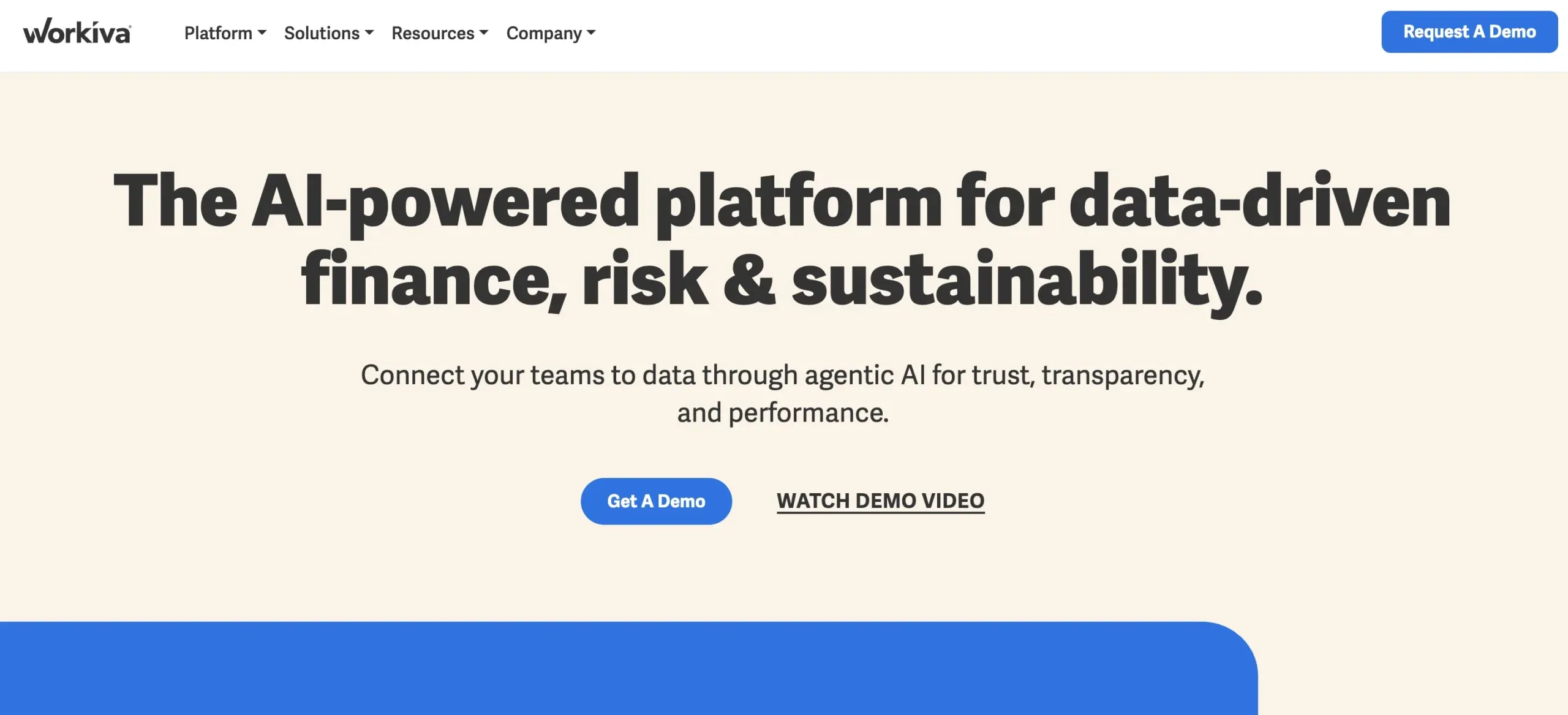
Workiva positions itself as an AI-powered platform for data-driven finance, risk, and sustainability. It is widely used by large enterprises to manage structured reporting processes that combine financial and non-financial data within a connected reporting environment.
Rather than focusing primarily on operational sustainability management, the platform is built around document-centric reporting workflows, supporting teams by:
- Connecting financial and ESG data within a single reporting environment
- Managing disclosures across frameworks such as CSRD, TCFD, and SEC requirements
- Producing audit-ready ESG disclosures aligned with regulatory frameworks and investor expectations
- Enabling collaboration between finance, sustainability, and compliance teams on reporting outputs
Workiva’s capabilities help organizations standardize the creation, review, and publication of disclosures across finance and sustainability reporting processes.
Workiva’s core features and capabilities
Connected reporting and linked data
One of Workiva’s core differentiators is its connected reporting architecture. The platform links data across reports, spreadsheets, and presentations, so updates made in one location automatically flow across reporting outputs.
This helps reduce manual rework and improves consistency across complex reporting environments, particularly where ESG disclosures need to align with financial filings, board reporting, and investor communications.
ESG reporting and disclosure management
Workiva supports ESG reporting across a range of regulatory and voluntary frameworks, as well as other sustainability reporting requirements.
The platform is designed to help organizations manage disclosure workflows within a centralized reporting environment, making it easier to coordinate reviews, approvals, and publishing processes across multiple stakeholders.
Governance, auditability, and compliance workflows
Governance and auditability are central to Workiva’s positioning. The platform provides version control, approval workflows, permissions management, and full audit trails to support regulated reporting processes.
This is particularly important in environments where sustainability reporting is closely tied to internal controls, assurance requirements, and finance-led governance structures.
Workiva AI and reporting automation
Workiva includes embedded AI capabilities designed to support reporting productivity and workflow efficiency. These tools can assist with drafting, summarization, analysis, and other repetitive reporting tasks within the platform.
The AI functionality is positioned around helping teams manage large reporting workloads more efficiently while maintaining governance and human oversight across reporting processes.
Enterprise collaboration and integrations
Workiva is built to support collaboration across finance, sustainability, risk, audit, and compliance teams. The platform also integrates with enterprise systems and external data sources to centralize reporting inputs within a governed environment.
This is particularly useful for large organizations managing ESG data across multiple departments, reporting teams, and operational systems.
Notable Workiva case study
Bolt, a European mobility platform operating across Europe and Africa, uses Workiva to manage financial and sustainability reporting within a unified reporting environment.
Before implementing Workiva, Bolt relied heavily on manual reporting workflows using spreadsheets and Word documents. As reporting complexity increased, the company needed a more centralized and auditable approach to managing both financial and sustainability disclosures.
Workiva was implemented to help Bolt:
- Automate financial and sustainability reporting workflows
- Create a centralized source of truth for reporting data
- Connect ERP and finance systems within a unified reporting environment
- Improve collaboration between finance, sustainability, and audit teams
- Support CSRD reporting and disclosure requirements with stronger governance and auditability
The example reflects the type of environment where Workiva is typically strongest.
Potential limitations and considerations
Workiva is designed primarily around reporting, governance, and disclosure management. Organizations that need broader operational sustainability workflows across procurement, operations, supply chain, and sustainability teams may still require additional systems or processes outside the platform.
Review feedback commonly highlights that the platform is best suited to larger enterprise environments with mature reporting and governance structures. Organizations with simpler reporting requirements may find the implementation scope and reporting architecture more extensive than necessary for their current needs.
Some users also note that the platform can involve a learning curve, particularly for teams unfamiliar with enterprise reporting systems. As reporting complexity increases across departments and frameworks, onboarding, workflow configuration, and governance management can become more resource-intensive.
Organizations comparing Workiva with other ESG and sustainability platforms can also explore our guide to Workiva alternatives.
How Sweep compares to Workiva
Workiva and Sweep approach sustainability management from different starting points.
Workiva is primarily designed for regulated reporting, governance, and disclosure management, while Sweep is positioned as a sustainability intelligence platform that connects sustainability data, workflows, and operational decision-making.
Organizations evaluating the two platforms need to decide on what approach they want to take. One is a reporting-centric operating model, and the other is a broader sustainability management system that supports ongoing collaboration across multiple business functions.
| Area | Sweep | Workiva |
| Core focus | Sustainability management, workflows, and business intelligence | Reporting, governance, and regulated disclosures |
| Primary users | Sustainability, operations, procurement, finance, and supply chain teams | Finance, compliance, risk, and reporting teams |
| Reporting approach | Workflow-driven sustainability data management | Connected reporting and disclosure management |
| Sustainability workflows | Continuous operational collaboration across teams | Structured reporting and approval workflows |
| Scope 3 management | Supplier collaboration and operational sustainability workflows | Disclosure-focused reporting processes |
| AI positioning | Sustainability workflow automation and operational insights | Reporting productivity and document automation |
In a nutshell:
Workiva is effective in environments where ESG reporting sits close to finance and compliance operations.
Sweep is better aligned with organizations looking to connect reporting, supplier engagement, sustainability operations, and business performance within a broader sustainability management system.
Choosing the right approach to sustainability management
Workiva is particularly well-suited to enterprise environments where sustainability reporting is closely tied to finance, governance, and regulatory disclosures. Its strengths are centered around connected reporting, auditability, and structured disclosure workflows across complex reporting environments.
However, organizations looking to connect sustainability reporting with supplier engagement, operational workflows, and broader sustainability performance management may require a more workflow-driven sustainability system.
Book a demo to see how Sweep helps organizations connect sustainability reporting, operational workflows, and sustainability intelligence within a single platform.