
Greenly is an AI-powered sustainability platform that brings carbon accounting, ESG reporting, supplier engagement, life cycle assessments, and decarbonization into a single environment.
A key part of Greenly’s approach is combining sustainability software with AI-powered automation and dedicated climate expertise. Through its EcoPilot AI and specialist climate advisors, the platform aims to reduce manual sustainability work while helping organizations accelerate reporting, improve Scope 3 data collection, and support long-term climate strategy.
But is it the right platform for your organization?
This review explores Greenly’s approach to AI-powered sustainability management, its core capabilities, and the types of businesses it’s designed to support.
What is Greenly and who is it best suited for?
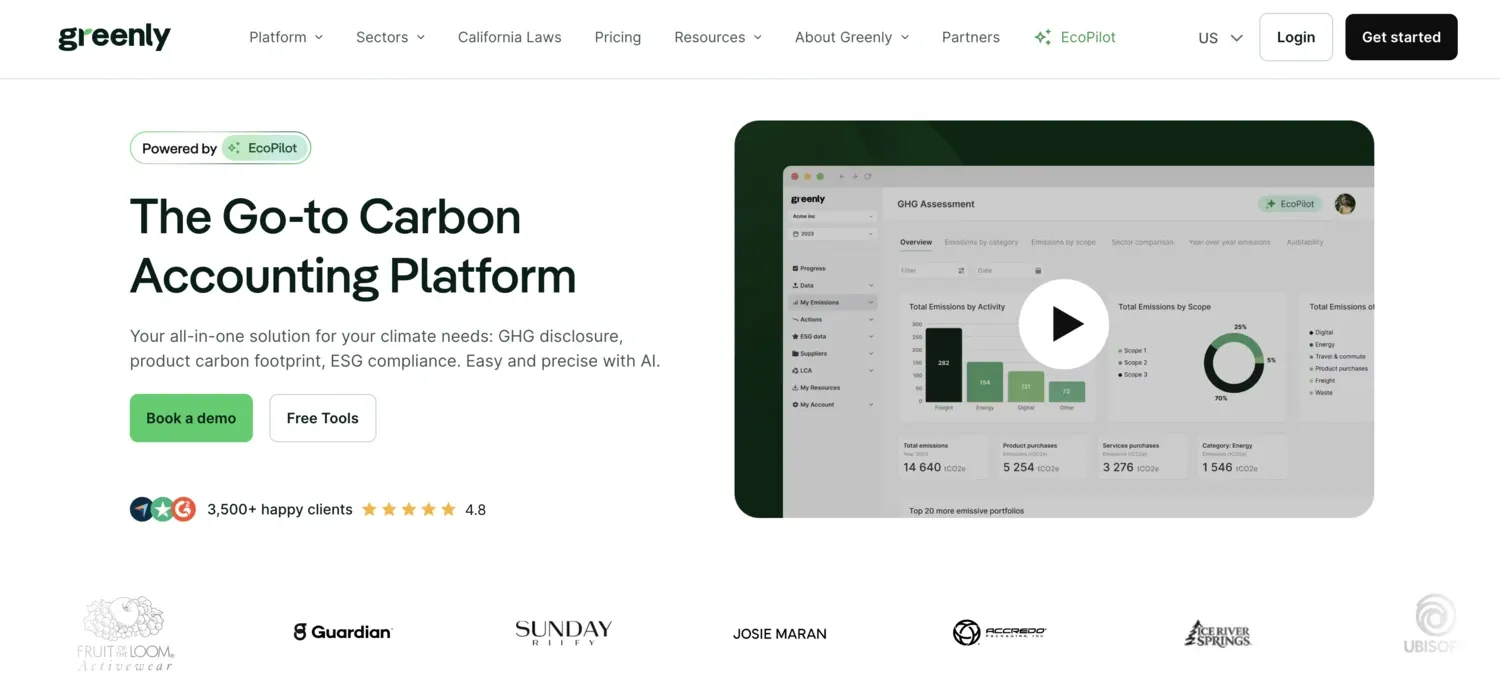
Greenly is an AI-powered sustainability platform built to turn sustainability into profitability.
The platform combines carbon management, life cycle assessment (LCA), and ESG management capabilities with AI-powered automation and dedicated climate expertise. Alongside measuring Scope 1, 2, and 3 emissions, Greenly supports supplier engagement, product carbon footprints, sustainability reporting, and compliance across a range of voluntary frameworks and regulatory requirements.
Greenly is designed to reduce the manual effort involved in managing sustainability data, reporting, and climate initiatives, while helping teams improve data quality, accelerate reporting, and identify opportunities to embed sustainability into broader business performance.
It’s a great choice for businesses looking to:
- Measure and manage Scope 1, 2, and 3 emissions using automated carbon accounting
- Improve supplier engagement and Scope 3 data collection across the value chain
- Conduct life cycle assessments and product carbon footprint analysis
- Support ESG reporting across frameworks and regulations such as TCFD, IFRS, SBTi, EcoVadis, CSRD, California climate laws, CBAM, EUDR, and Digital Product Passport (DPP)
- Develop decarbonization strategies with AI-powered insights and dedicated climate expertise
This combination of software, AI, and expert guidance enables sustainability teams to accomplish more without proportionally increasing internal resources.
Greenly’s core features and capabilities
EcoPilot and AI-powered sustainability workflows
EcoPilot is central to Greenly’s positioning and one of its biggest differentiators. Rather than relying on a single AI assistant, it uses a team of specialist AI agents focused on specific areas of the sustainability workflow.
- The Architect structures sustainability data and performs quality checks
- The Scope 3 Scout researches suppliers and enriches emissions data
- The Environmental Engineer accelerates life cycle assessment modeling
- The Strategist supports benchmarking, ESG reporting, and executive decision-making
Together, these capabilities reduce manual work, improve data quality, and expand what sustainability teams can accomplish. Greenly combines this agentic AI approach with chatbot functionality and dedicated climate experts, giving businesses both AI-powered automation and specialist guidance as they manage sustainability initiatives.
Carbon management and supplier engagement
Greenly supports carbon accounting for Scopes 1, 2, and 3, giving businesses a centralized view of emissions across their operations and value chain.
The platform places particular emphasis on Scope 3 management through supplier-engagement workflows, AI-assisted data enrichment, and value-chain collaboration. This helps organizations improve the completeness and accuracy of supplier emissions data and identify opportunities to reduce emissions across their supply chains.
ESG reporting and regulatory compliance
Greenly supports ESG reporting across a growing range of sustainability frameworks and regulatory requirements. The platform includes capabilities for reporting aligned with standards such as TCFD, IFRS, and SBTi, as well as supporting regulations such as California climate laws, CBAM, EUDR, and the Digital Product Passport (DPP).
By centralizing sustainability data and compliance processes, Greenly aims to reduce the administrative effort required to manage multiple disclosure requirements.
Life cycle assessment and product sustainability
Greenly includes life cycle assessment (LCA) capabilities that help organizations understand the environmental impact of products across their lifecycle. The platform supports product carbon footprint analysis, ISO-aligned assessments, and bill of materials (BOM) imports to improve product-level sustainability insights.
These capabilities allow businesses to evaluate design choices, compare suppliers or materials, and incorporate environmental considerations into product development and procurement decisions.
Decarbonization strategy and climate expertise
Beyond measurement and reporting, Greenly supports decarbonization planning and strategies. The platform supports hotspot analysis, target setting, supplier collaboration, and reduction planning, making it great for teams that prioritize climate initiatives.
Greenly complements these capabilities with dedicated climate experts who guide methodology, reporting, and decarbonization strategy, helping teams identify where emissions reductions can deliver the greatest impact.
Notable case study
Siemon, a global manufacturer of network infrastructure solutions, partnered with Greenly to improve the accuracy of its carbon accounting and build a stronger foundation for its net-zero strategy. Before implementing the platform, the company faced inaccurate emissions baselines, fragmented data collection across spreadsheets, and limited visibility into emissions across its operations and supply chain.
Greenly worked with Siemon to:
- Recalculate its emissions baseline in line with SBTi requirements
- Improve Scope 1, 2, and 3 emissions tracking across the business
- Centralize sustainability data and reduce manual reporting processes
- Create more granular emissions data to support targeted decarbonization initiatives
- Strengthen confidence in sustainability reporting and long-term climate planning
The implementation increased carbon accounting accuracy to more than 90%, reduced annual carbon accounting time from 1,080 hours to just 40 hours, and lowered consultancy costs by 60%. Siemon also drove employee participation in sustainability initiatives and expanded renewable electricity usage from 30% to 50%, demonstrating how improved sustainability data can support broader operational improvements.
Potential limitations and considerations
Greenly’s strengths are centered on AI-powered automation, carbon management, and expert-supported sustainability execution. Organizations that need wider-reaching sustainability coordination across finance, procurement, operations, and executive teams should also evaluate platforms with a stronger emphasis on enterprise-wide management and operational visibility.
The platform’s combination of software and dedicated climate expertise is a key part of its value proposition. Businesses comparing different approaches may also consider whether they prefer this expert-supported model or a platform built primarily around internal collaboration and organization-wide sustainability management.
How does Sweep compare to Greenly?
Sweep and Greenly both help organizations manage sustainability across carbon accounting, ESG reporting, supplier engagement, and decarbonization.
However, they take different approaches to the challenge of scaling sustainability programs.
| Area | Sweep | Greenly |
| Core focus | Sustainability intelligence, workflows, and business performance | AI-powered sustainability management and climate execution |
| Primary users | Sustainability, operations, procurement, finance, and supply chain teams | Sustainability, ESG, and climate teams |
| Reporting approach | Workflow-driven sustainability data management across the enterprise | AI-assisted reporting and regulatory compliance |
| Scope 3 management | Supplier collaboration and operational sustainability workflows | AI-assisted supplier engagement and Scope 3 data collection |
| Sustainability workflows | Organization-wide sustainability coordination and operational management | AI-powered carbon management, reporting, and decarbonization workflows |
| AI positioning | Agentic workflow automation and sustainability intelligence | EcoPilot AI with specialist sustainability agents and dedicated climate expertise |
| Best suited for | Organizations connecting sustainability data with operations and strategy | Organizations looking to scale sustainability through AI-powered automation and expert guidance |
In a nutshell:
Greenly is strongest for organizations looking to automate carbon management, reporting, supplier engagement, and decarbonization through a combination of AI-powered workflows and dedicated climate expertise.
Sweep may be a better fit for organizations that want to connect sustainability reporting, operational workflows, supplier collaboration, financed emissions, and business performance within a single environment.
Choosing the right approach to AI-powered sustainability management
If a business wants to scale its sustainability capabilities through AI-powered automation, dedicated climate expertise, and structured carbon management, Greenly is a great partner. Its strengths lie in reducing manual work, improving reporting efficiency, strengthening Scope 3 data collection, and building practical decarbonization strategies supported by both software and specialist guidance.
As sustainability becomes more integrated across the business, many organizations also need to connect carbon accounting with operational workflows, supplier collaboration, financed emissions, ESG reporting, and business performance. In these environments, the priority shifts from managing individual sustainability activities to coordinating sustainability across multiple teams and business functions within a single platform.
Book a demo to see how Sweep connects sustainability reporting, operational workflows, supplier engagement, and sustainability intelligence across the enterprise.
Disclaimer: The information in this article is based on publicly available sources, including vendor websites, product documentation, and other published materials, at the time of writing. Product features, pricing, and capabilities may change over time. If you identify any inaccuracies or would like us to review updated information, please contact us.