
Normative is a carbon accounting platform that gives businesses defensible data and numbers that they can build their net zero plan around.
Its positioning extends beyond producing a carbon footprint. Normative emphasizes traceable calculations, audit-ready reporting, supplier engagement, and expert guidance, giving sustainability teams a reliable foundation for disclosures, target setting, and long-term decarbonization.
As carbon reporting requirements become more rigorous, many organizations are looking for platforms that deliver both accurate calculations and confidence in the underlying data.
This review explores Normative’s approach to carbon accounting, its core capabilities, and where it fits within the broader sustainability software landscape.
What is Normative and who is it best suited for?
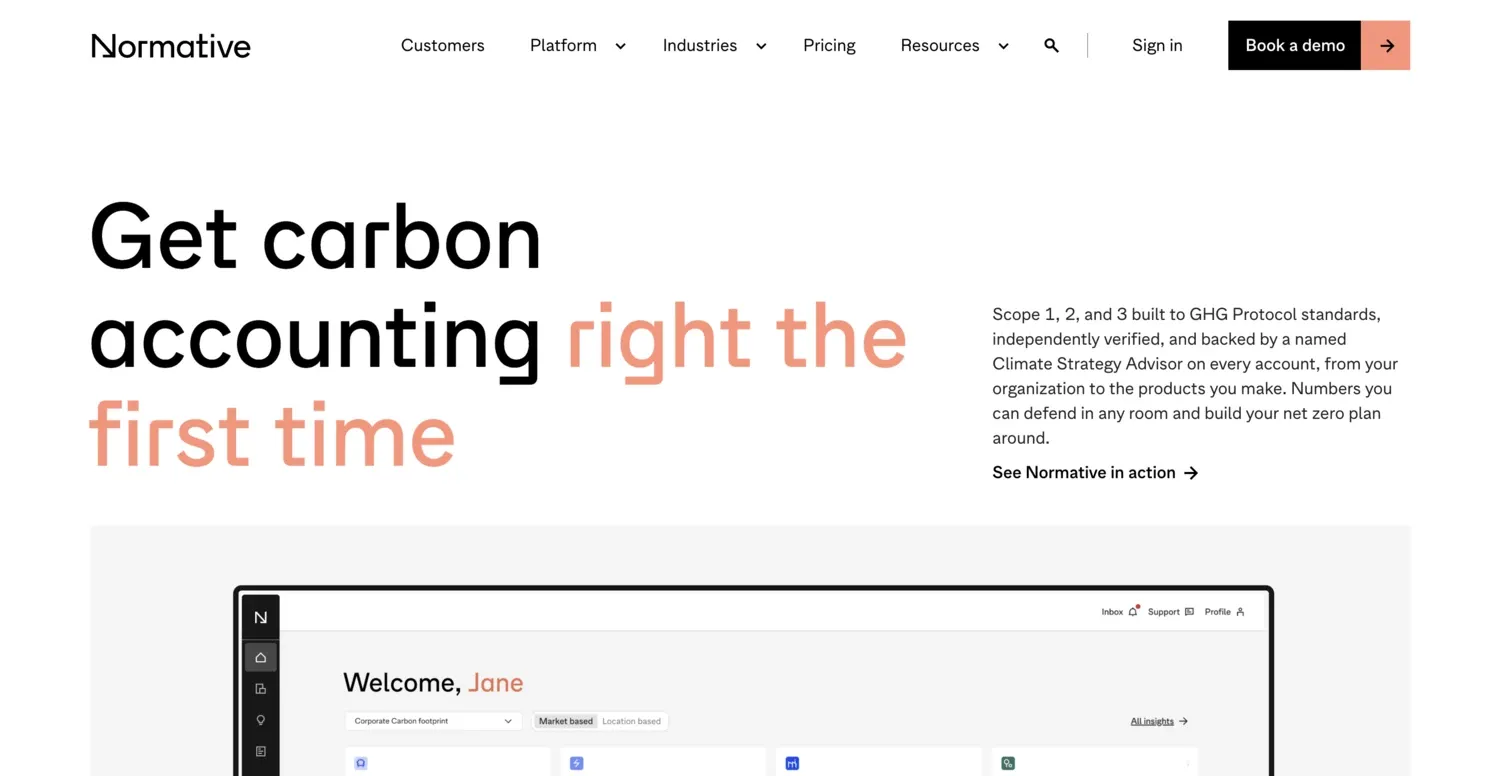
Normative is a carbon accounting platform that enables businesses to measure, report, and reduce greenhouse gas emissions with greater confidence. Built around GHG Protocol-aligned methodologies and independently verified calculations, the platform emphasizes transparency, traceability, and scientific rigor across Scope 1, 2, and 3 reporting.
A key part of Normative’s approach is combining software with dedicated Climate Strategy Advisors.
Every customer works with a named advisor who provides ongoing guidance around methodology, reporting, target setting, and carbon reduction planning. Together with automated data collection and carbon accounting workflows, this creates a reliable foundation for climate disclosures and long-term decarbonization.
Businesses choose Normative to:
- Measure Scope 1, 2, and 3 emissions using GHG Protocol-aligned methodologies
- Produce audit-ready carbon inventories with full calculation traceability
- Strengthen supplier engagement and improve Scope 3 data quality
- Prepare for reporting requirements such as CSRD, CDP, and CBAM
- Build science-based targets and long-term decarbonization strategies with expert guidance
This combination of trusted carbon accounting, automation, and dedicated climate expertise gives sustainability teams confidence in the quality of their emissions data while freeing up more time to focus on strategic climate action.
Normative’s core features and capabilities
Carbon accounting and Climate Strategy Advisors
Carbon accounting sits at the core of the Normative platform. It supports Scope 1, 2, and 3 emissions measurement using GHG Protocol-aligned methodologies, combining automated data collection, AI-assisted categorization, and more than 349,000 verified emission factors to produce accurate, traceable emissions inventories.
Every account also includes a named, GHG Protocol-certified Climate Strategy Advisor who provides ongoing guidance around methodology, reporting, target setting, and audit preparation.
Supply chain engagement and Scope 3
Normative places significant emphasis on Scope 3 emissions, recognizing that value chain emissions represent the largest share of many organizations’ carbon footprints. Through its Engage Module and Carbon Network, businesses can collect primary supplier emissions data, strengthen supplier collaboration, and improve the quality of Scope 3 reporting.
This gives sustainability teams greater visibility into supplier emissions while creating a stronger foundation for emissions reduction planning and stakeholder reporting.
Carbon reporting and product sustainability
Normative supports carbon reporting across requirements such as CSRD, CDP, CBAM, and SBTi, using a centralized carbon data foundation that can be reused across disclosure processes. Independent verification, transparent calculations, and full audit trails give organizations greater confidence in the quality of their reporting.
The platform also includes Product Carbon Footprint (PCF) capabilities, enabling businesses to measure product-level emissions and incorporate carbon data into product design, procurement, and sustainability reporting.
Decarbonization planning
Beyond emissions measurement, Normative enables businesses to identify emissions hotspots, prioritize opportunities for reduction, and build credible decarbonization strategies based on trusted carbon data. Organizations can use these insights to support science-based targets, engage suppliers, and track progress toward long-term net-zero commitments.
By connecting accurate carbon accounting with practical emissions-reduction planning, the platform provides sustainability teams with a stronger basis for strategic decision-making.
Notable case study
The Restaurant Group (TRG), one of the UK’s largest hospitality businesses with approximately 300 sites and 15,000 employees, partnered with Normative to strengthen its carbon accounting and gain a clearer understanding of emissions across its operations and supply chain.
With around 95% of its emissions falling within Scope 3, the company needed a more comprehensive approach to measuring emissions and engaging with suppliers.
Normative was implemented to help TRG:
- Build a comprehensive view of Scope 1, 2, and 3 emissions
- Improve supplier engagement and collect primary emissions data
- Identify emissions hotspots across its value chain
- Create a stronger foundation for sustainability reporting and reduction planning
- Support long-term decarbonization with expert guidance from Climate Strategy Advisors
Using Normative, TRG identified that 75% of its emissions came from purchased goods and services and used the platform to engage its highest-emitting suppliers through the Engage Module. The result was a more transparent view of its supply chain, a stronger foundation for sustainability reporting, and clearer priorities for reducing emissions as it progresses toward its 2040 net-zero target.
Potential limitations and considerations
Normative’s strengths are centered on accurate, defensible carbon accounting supported by independently verified methodologies and dedicated climate expertise.
For organizations using carbon data beyond reporting – for example, to support procurement decisions, supplier engagement, operational performance, or executive planning – additional capabilities may become increasingly important. This can include ESG management, financed emissions, sustainability intelligence, and cross-functional collaboration.
Businesses evaluating long-term platform needs may want to compare carbon accounting platforms like Normative with solutions that support a broader range of sustainability activities and more closely connect sustainability data to day-to-day operations and strategic decision-making.
How does Sweep compare to Normative?
Sweep and Normative both support enterprise sustainability efforts, but they approach the challenge from different perspectives.
| Area | Sweep | Normative |
| Core focus | Sustainability intelligence, workflows, and business performance | Carbon accounting, climate reporting, and defensible emissions data |
| Primary users | Sustainability, operations, procurement, finance, and supply chain teams | Sustainability, finance, and climate teams |
| Reporting approach | Workflow-driven sustainability management across the business | GHG Protocol-aligned carbon accounting and climate reporting |
| Scope 3 management | Supplier collaboration and operational sustainability coordination | Supplier engagement and verified Scope 3 carbon accounting |
| Expert support | AI-powered sustainability workflows | Named Climate Strategy Advisors on every account |
| Best suited for | Organizations connecting sustainability data with operations and strategy | Organizations prioritizing trusted carbon accounting and climate reporting |
In a nutshell:
Normative is a very good fit for organizations where accurate carbon accounting, scientifically robust methodologies, and trusted climate reporting are the primary priorities.
Sweep is a better fit for organizations looking to connect sustainability reporting with operational execution, supplier collaboration, financed emissions, and sustainability intelligence across the business.
Choosing the right approach to carbon accounting
Normative is built for organizations that prioritize accurate carbon accounting, transparent methodologies, and trusted emissions data. Its combination of independently verified calculations, dedicated Climate Strategy Advisors, and robust Scope 3 capabilities provides a reliable foundation for climate reporting, target setting, and long-term decarbonization.
As sustainability data becomes more valuable across the business, many organizations also want to connect carbon accounting with supplier collaboration, ESG reporting, operational decision-making, and broader sustainability initiatives. In these environments, the focus shifts from producing reliable emissions data to using that data to coordinate sustainability activities and inform business performance.
Book a demo to see how Sweep helps organizations connect sustainability reporting, operational workflows, supplier engagement, and sustainability intelligence across the enterprise.
Disclaimer: The information in this article is based on publicly available sources, including vendor websites, product documentation, and other published materials, at the time of writing. Product features, pricing, and capabilities may change over time. If you identify any inaccuracies or would like us to review updated information, please contact us.